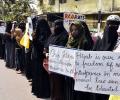
The Allahabad high court has dismissed a petition filed by a minor student of a school in Prayagraj. The petitioner had sought permission to wear a hijab additionally along with the prescribed school dress code while attending classes.

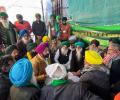
Uttar Pradesh Deputy Chief Minister Brajesh Pathak met with students leading a "reservation reform" movement, assuring them that their demands would be presented to the BJP's central leadership and a Union minister. The movement, led by anti-reservation activists, seeks equal opportunities, while Samajwadi Party chief Akhilesh Yadav criticised the "reform" as a plot against the PDA community, asserting the permanence of reservation rights.
India has rejected allegations of human rights violations for the second time in three days, emphasising its constitutional values of justice, liberty, and freedom of expression. The remarks were made by Sibi George, Secretary (West) in the Ministry of External Affairs, in response to questions from a Norwegian journalist.

BJP MP Raghav Chadha addressed the 12th IPU Global Conference of Young Parliamentarians in Samarkand, Uzbekistan, highlighting India's digital transformation journey. He emphasised how technology is widening access and promoting inclusion, citing UPI's success, affordable data, and robust data protection laws. Chadha also discussed India's digital cooperation with Uzbekistan and the importance of digital rights, safety, and skill development for all citizens.

The Supreme Court has sought the Centre's response on a petition challenging the constitutional validity of polygamy among Muslims, arguing it violates fundamental rights and creates legal asymmetry by exempting Muslim men from bigamy laws applicable to other citizens.

The Students and Alumni of the National Law School of India University (NLSIU) in Bengaluru have opposed Chief Justice of India Surya Kant and Bar Council of India chairman Manan Kumar Mishra attending the upcoming convocation of the varsity.
Earlier, senior advocate A M Singhvi, appearing for the former Lakshadweep MP, had submitted that the person has not been reinstated as an MP despite his conviction and sentence being stayed by the high court.

The Supreme Court questioned the West Bengal government regarding its objection to the maintainability of the Enforcement Directorate's plea concerning alleged obstruction by Chief Minister Mamata Banerjee during a raid, focusing on the fundamental rights of ED officers.

A former IPS officer and two individuals injured during a recent protest in Delhi have filed a petition in the Supreme Court seeking a ban on the use of pellet guns by law enforcement agencies for crowd dispersal. The petitioners argue that pellet guns are an arbitrary and dangerous tool, violating the right to freedom of assembly and failing the test of necessary and proportional force. They also seek compensation and medical treatment for victims.

'It is unfortunate that the Chairman of Tata Sons, a Company renowned for setting high standards of corporate governance, is contending reappointment on such an untenable interpretation of the Articles'.

Attorney General K K Venugopal resumed his arguments before a nine-judge bench headed by Chief Justice J S Khehar, stressing that it was not a fundamental right.

After nearly 19 years, exiled Bangladeshi author Taslima Nasreen returned to Kolkata, calling it a deeply emotional homecoming.

'The government wants to ban surrogacy and take away women's fundamental right to do what she wants with her body.'

A Pune court has granted bail to NCP (SP) office-bearer Mahadev Balgude, ruling that criticism of the government or chief minister does not constitute "waging war" against the nation. The court emphasised every citizen's right to comment on and criticise government actions, noting that the charges under Bharatiya Nyaya Sanhita Section 152 were debatable.

UEFA, the Asian Football Confederation (AFC), and CONCACAF have jointly criticised FIFA President Gianni Infantino for his handling of a proposed sale of commercial rights to the World Cup, accusing him of 'deception' and calling for an independent review.
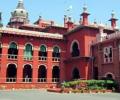
Narrating the role of Vadivelu in Maamannan, the judge said the eighth respondent Karuppu faced a similar situation in this case.

The Centre had termed privacy as a 'vague and amorphous' right which cannot be granted primacy to deprive poor people of their rights to life, food and shelter.
Regional OTT platform STAGE is set to release India's first AI-made biopic on farmer leader Sir Chhotu Ram. The project leverages artificial intelligence for various aspects of filmmaking, from visualisation to character generation, aiming to reduce production costs and expand storytelling possibilities for underserved cultures and languages.
Privacy is liberty itself. And in ruling on it, the Supreme Court must not only seize the concerns of today but also gaze into the future, says Apar Gupta.

Tamil Nadu Chief Minister C Joseph Vijay announced the withdrawal of police cases against farmers who protested against the Parandur airport and SIPCOT projects, and against teachers who protested for their rights. The decision, made on humanitarian and democratic grounds, aims to strengthen democratic rights and public trust in the government.

UST, a California-based technology company, highlights India's unique opportunity to build an AI-native semiconductor ecosystem, bypassing older models. Speaking at SEMICON India 2026, UST COO Gilroy Mathew emphasised India's advantage in investing in infrastructure and talent at the right time, enabling it to create AI-native manufacturing and supply chains for future competitiveness.

Olympian Maheshwari Chauhan discusses the significance of India's historic women's skeet bronze medal at the Asian Games, highlighting it as a turning point for the discipline. She believes the medal, achieved with Raiza Dhillon and Parinaaz Dhaliwal, signals a new era for Indian shotgun shooting, driven by a younger generation, improved training, and a stronger foundational ecosystem.

The judge noted that there is a long wait for adoption and there are many childless couples and parents with one child who would adopt a "normal child" but the chances of a specially-abled child being adopted are remote and the regulation therefore only aims to ensure that more and more children with special needs get adopted.
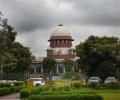
The Supreme Court has sought responses from the Centre and state governments on a Public Interest Litigation (PIL) advocating for the confiscation of movable and immovable property belonging to individuals and their family members involved in exam question paper leak cases. The plea also calls for invoking various anti-corruption and financial crime acts against perpetrators and suggests consecutive sentencing for such offences.

India has reiterated its commitment to human rights and democracy following criticism from a Norwegian newspaper commentator during Prime Minister Modi's visit to Norway.

The Congress party has demanded the resignation of Chief Election Commissioner Gyanesh Kumar, alleging "vote chori" and treason, following a media report revealing that two other Election Commissioners had formally objected to decisions regarding the Special Intensive Revision of electoral rolls. Rahul Gandhi and Mallikarjun Kharge have accused the BJP, RSS, and EC of undermining democracy, citing concerns over voter list tampering and lack of transparency.
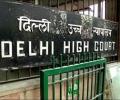
The right to seek 'default' bail is a fundamental right and an indefeasible part of right to personal liberty under the Constitution which cannot be suspended even during a pandemic situation, the Delhi high court said.

Former BJP leader K Annamalai has criticised the Centre for its handling of the NEET issue, alleging a lack of accountability despite three question paper leaks and questioning the delay in engaging with student protesters.

A Reddit post about a hidden camera in a shared living room has reopened an old question -- how far can a landlord interfere in a home he no longer fully controls? Here's what two Mumbai lawyers have to say.

The Supreme Court of India has directed all states and Union territories to operationalise a single helpline number '112' for emergency responses and establish a functional good samaritan grievance redressal system within three months, emphasising that the right to trauma care is an integral part of the right to life.

'The issue appears to be less about Chandrasekaran personally and more about the direction Tata Sons should take.'
The top court rejected the Centre's vehement contention that there was no general or fundamental right to privacy under the Constitution.

Chief Justice of India Surya Kant stated that while artificial intelligence (AI) can augment judicial reasoning, it cannot substitute judicial conscience, and a permanent apex body is proposed to supervise AI adoption and accountability within the judiciary.

Meta has agreed to report child safety-related matters, including child sexual abuse cases, to appropriate law enforcement agencies in India, government sources confirmed, emphasising that online safety for children is a "non-negotiable" fundamental principle for social media platforms operating in the country.

The Delhi High Court has recognised an individual's 'right to be forgotten', ruling that search engines cannot perpetually display judicial records in name-based searches for private cases or those ending in acquittal.

Putin has issued a stark warning to European nations, declaring that any deployment of troops to Ukraine would be met with 'war with Russia'.

The Supreme Court has clarified that 'criminal antecedents' for NEET paper leak protesters refer only to grave and heinous offences, allowing state governments to withdraw FIRs against students not involved in such serious crimes. This comes after the Centre's commitment to not pursue cases against most protesting students.

Sri Lanka's interim cricket board is committed to fundamental reforms to ensure the inaugural Women's Champions Trophy in 2027 remains in the country. This comes amidst speculation that the ICC might relocate the event due to government interference in the sport's administration, with the ICC having previously indicated a search for alternative venues.
The Supreme Court is scheduled to hear on August 31 a plea which has challenged the validity of a provision of the Income Tax Act that allows political parties to receive cash donations below Rs 2,000.

The Indian Olympic Association (IOA) has approved significant constitutional changes to align with the National Sports Governance Act (NSGA), allowing for longer tenures for office-bearers and revising age limits. These amendments, which have received preliminary approval from the International Olympic Committee (IOC), also impact the structure of the Executive Council and set the stage for upcoming elections, including those for the Athletes' Commission.
